LLMs vs JEPA: Two Very Different Bets on the Future of AI
LLMs predict the next word. JEPA predicts the next "meaning" — in latent space, not pixels or tokens. That one difference explains why LLMs are great at language but bad at physics, and why JEPA is quietly becoming the backbone of real robotics.
- #llsms
- #jepa
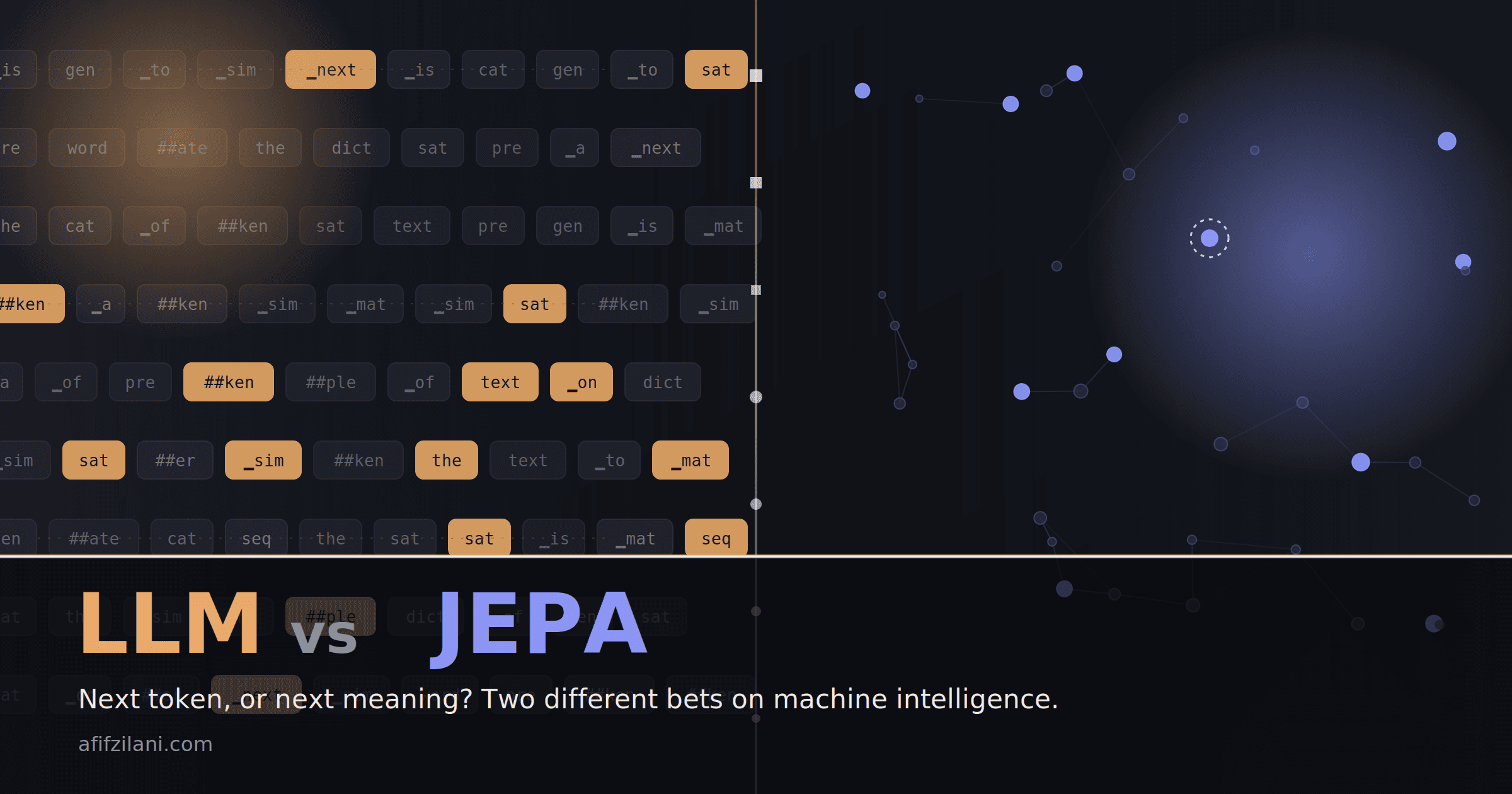
If you've spent any time around AI Twitter (or X, whatever we're calling it this week), you've probably seen Yann LeCun say — again — that LLMs are not the path to real intelligence. It sounds like a hot take. It isn't. It's the surface of a genuinely different architecture called JEPA, and understanding the difference actually tells you something useful about where AI is heading.
So let's break it down properly. No hand-waving, no "AI will change everything" fluff — just what these two things are, how they differ, and what's realistic to expect.
Q1. What is an LLM?
An LLM (Large Language Model) is a system trained to predict the next token in a sequence. You feed it a chunk of text, it guesses what comes next, you correct it, repeat that a few trillion times over the internet's worth of text, and eventually it gets scary good at completing text in ways that look like reasoning, coding, writing, whatever you throw at it.
Under the hood it's the Transformer architecture — self-attention, autoregressive generation, one token at a time. Everything ChatGPT, Claude, or Gemini does is a byproduct of this one training objective scaled up to absurd size. That's it. It's not "understanding" in the way you and I mean the word — it's an extremely good statistical model of what text tends to follow what text.
Q2. What is JEPA?
JEPA — Joint Embedding Predictive Architecture — is Yann LeCun's alternative, first laid out in his 2022 position paper A Path Towards Autonomous Machine Intelligence. The core idea: instead of predicting raw pixels or tokens, predict an abstract representation of the missing or future part of the input.
Take a video. Instead of trying to generate what the next frame looks like pixel by pixel, JEPA predicts an embedding — a compressed vector — that captures the frame's meaning: where things are, how they're moving, what matters. It deliberately throws away irrelevant detail like exact lighting or noise.
LeCun's argument for why this matters is blunt: predicting pixel-by-pixel gives you a "blurry average" of possible futures, not real understanding. Predicting in latent space forces the model to actually learn the structure of the world instead of memorizing surface texture.
Q3. What's the actual difference?
| LLM | JEPA | |
|---|---|---|
| Predicts in | Token space (words/symbols) | Latent/embedding space (abstract meaning) |
| Learns from | Text, code | Video, images, sensor data |
| Good at | Language, symbolic reasoning, planning in words | Physical intuition, "what happens next," grounded perception |
| Weak at | Physical causality, hallucinates confidently | Language, abstract multi-step logic |
| Output | Generates content token-by-token | Predicts a compact representation, decodes only if needed |
The one-line version: LLMs are trained to talk. JEPA is trained to perceive and predict physical reality. Different training objective, different strengths, different failure modes.
Q4. Current top models — and where they're actually used
LLMs (mid-2026 snapshot): the field is genuinely crowded now — OpenAI's GPT-5.5, Anthropic's Claude Opus 4.8 and Claude Sonnet 5, with the new Mythos-tier Claude Fable 5 sitting at the very top of most reasoning leaderboards, Google's Gemini 3.1 Pro (still the pick for huge documents and video), and a fast-improving open-weight pack — DeepSeek V4, Qwen 3.7 Max, GLM 5.2 — that's closing the gap on coding benchmarks while costing a fraction of the frontier models. These power chatbots, coding assistants (Claude Code, Cursor, Codex), enterprise document work, customer support agents — basically anything language- or knowledge-shaped.
JEPA models: these are far more niche, deliberately so — this is still research-stage. I-JEPA and V-JEPA started as image/video representation learners. V-JEPA 2 (2025) combined roughly a million hours of internet video with a small amount of robot trajectory data and got real robotics planning results. V-JEPA 2.1 (early 2026) sharpened that into denser, more spatially precise features. A newer model called LeWM took the same idea and made it brutally efficient — full plans in about a second instead of 47, on a single GPU. VL-JEPA extended the idea to vision-language tasks, beating comparable token-based models with half the parameters.
Bottom line: LLMs are shipping in products you use every day. JEPA is shipping in robotics labs and research benchmarks. That gap is real, not a coincidence.
Q5. What's the future — merge or compete?
Compete is the wrong frame. They solve different problems, so the realistic path is hybrid, modular systems — not one architecture eating the other. You're already seeing the first version of this: V-JEPA 2 aligned with an LLM for video question-answering, VL-JEPA predicting embeddings instead of tokens.
The likely shape: JEPA-style models handle fast, cheap, always-on physical perception and prediction — the "reflex" layer. LLMs handle slower, deliberate reasoning and language — the "System 2" layer that gets invoked less often. Not brain-and-mouth. More like: fast intuition module feeding a slow reasoning module, the same rough split cognitive scientists use to describe System 1 and System 2 thinking in humans.
What nobody has solved — in either architecture — is the goal-setting, value-judgment layer. Perception plus reasoning still isn't the same as an agent that knows what it should want. That's the actual hard problem left on the table.
Q6. How does this change our lives?
Honestly? For most people, not dramatically different from what LLMs are already doing — better writing tools, better coding assistants, smarter agents booking things and summarizing things. That trend continues regardless of JEPA.
Where it gets interesting is anything that touches the physical world. Right now, "AI" mostly means a chat window. JEPA-driven systems point toward AI that can watch, predict, and act in physical space reliably — which is the missing piece for home robots, more capable self-driving systems, and industrial automation that doesn't need painstaking hand-coded rules for every scenario.
Q7. Impact on robotics specifically
This is where JEPA is genuinely built for the job, and it's not subtle. V-JEPA 2 hit an 80% success rate in zero-shot robot control versus 15% for a comparable baseline, adapting to new environments with just 62 hours of unlabeled video. LeWM's latent-space planning is dozens of times faster than prior world-model approaches, running on hardware that fits in a lab rather than a data center.
Why this matters for robotics specifically: robots need to predict physical consequences before acting — will this object tip over, will this grip slip, what happens if I push here — and they need to do it in real time, cheaply. That's exactly the gap LLMs can't fill; they don't have a native sense of physics because they've never had to. Expect robotics and embodied AI to be the domain where JEPA-style world models show up first and most convincingly, well before it touches anything you'd call "general AI."
Q8. Current limitations
Being straight about this, because the hype cycle won't be:
LLMs: hallucination is still structural, not a bug that gets patched away — they're optimized for plausible text, not verified truth. No real world model, so they reason about physics and causality by pattern-matching text about physics, which breaks under novel situations. Expensive to run at frontier scale.
JEPA: still mostly research and robotics-lab stage, not consumer products. A May 2026 benchmark from LeCun's own group found current JEPA implementations collapse under minor visual shifts — the theory is getting rigorous (there's now a formal proof of when JEPA can recover true latent structure), but that proof only holds under clean assumptions like Gaussian latents and stationary dynamics. Real-world mess doesn't cooperate with clean assumptions. It also can't do language or abstract multi-step reasoning — that's simply not what it's built for.
Neither architecture is close to a system with actual goals, values, or general-purpose judgment. That gap is bigger than either of their current limitations.
Q9. Possible risks
A few worth taking seriously, not the sci-fi kind:
-
Overclaiming. Every hybrid-system pitch right now is more marketing than delivered product. AMI Labs, LeCun's own startup, raised over a billion dollars and its CEO publicly said it'll take roughly a year just to get something applicable to real products — that's an honest timeline, and worth remembering next time someone claims JEPA is "solved."
-
Robotics deployed on brittle world models. If a robot's internal physics prediction is wrong in an edge case — and the benchmark data says current models are still brittle under visual shifts — that's not an abstract research failure, it's a robot arm doing something unsafe near a person.
-
LLM hallucination compounding in agentic systems. As LLMs get wired into more autonomous, multi-step agent loops, a single confident wrong output can cascade through an entire task instead of staying contained to one chat reply.
-
Concentration of the physical-AI layer. If world models end up being expensive to train well (they need massive video + real interaction data), the "who controls the robots" question becomes a real infrastructure question, not a philosophical one.
Wrapping up
LLMs and JEPA aren't rivals fighting for the same crown — they're solving different problems that happen to both fall under "AI." LLMs own language and symbolic reasoning. JEPA is chasing physical grounding and world understanding. The realistic future isn't one replacing the other — it's hybrid systems where each does what it's actually good at, showing up first in robotics and embodied AI, long before it changes what you see in a chat window.
If someone tells you JEPA is about to make LLMs obsolete, or that LLMs are secretly already doing what JEPA does — neither is true. Ask them for the benchmark.